

National Assembly of the Republic of Serbia / Activities / Activity details
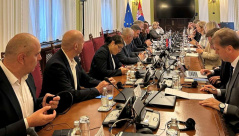
22 May 2025 The representatives of opposition parliamentary groups in meeting with the EU High Representative for Foreign Policy and Security Policy
Thursday, 22 May 2025
Representatives of Opposition Parliamentary Groups Meet with EU High Representative for Foreign Policy and Security Policy
Representatives of opposition parliamentary groups met today in the National Assembly with the EU High Representative for Foreign Policy and Security Policy and Vice-President of the European Commission, Kaja Kallas, currently in official visit to the Republic of Serbia.
The meeting was opened by MP Borko Stefanovic who said that the EU High Representative is visiting at an important moment of political and security crisis in Serbia, which has been going on for a long time and culminated in the tragic collapse of the canopy at the Novi Sad railway station, which triggered mass protests by students, the opposition, and citizens in Serbia.
Stefanovic pointed out that the regime currently rules with a repressive apparatus and usurped media, which carry out constant propaganda, emphasising that this propaganda is extremely anti-European. He assessed that the government does not want Serbia’s membership in the European Union, because its rapprochement with the EU would mean the fall of the government in Serbia. "Aleksandar Vucic is carrying out constant repression of the judiciary," Stefanovic stated, adding that "at the moment, three political activists are in prison for verbal offenses."
The meeting was also attended by MPs Miroslav Aleksic, Prof. Dr Biljana Djordjevic, Zdravko Ponos, Srdjan Milivojevic, Pavle Grbovic, Aleksandar Pavic, Aleksandar Jovanovic, Zeljko Veselinovic, Dr Ksenija Markovic and Minela Kalender.
The MPs informed the EU High Representative for Foreign Policy and Security Policy Kaja Kallas, in detail about all the important aspects of the current developments in Serbia, noting that the government is declaratively committed to European integration, but that Serbia's foreign policy is not being aligned with the European one, nor are reforms being implemented in the field the judiciary, media and the fight against corruption, or the ODIHR recommendations regarding the reform of electoral legislation and electoral conditions.
They emphasised that it is extremely important for the EU to support the students and citizens and assessed that the perception of the European Union in our public, which is currently at a historic low, will largely depend on the attitude that the EU will have toward the citizens of Serbia in the coming period, which is a consequence of the anti-European media propaganda in Serbia, as well as the attitude of certain officials from Brussels.

sunday, 5 april
No announcements for selected date